Someone Copied Your Framework? What You Can Actually Protect (and What You Can't)
A former student just launched a new program. The same steps, in the same order, with the same promise as yours, just a different name on the front. Maybe they even borrowed your words for step three. Your stomach drops, and your first thought is, "They ripped me off. I'm calling my lawyer."
Hold on. I'm the lawyer. Before you post a public call-out or send a nasty message, I'm going to ask you to do something harder: figure out which kind of problem this actually is. Business moments like this are predictable, and your panic is optional.
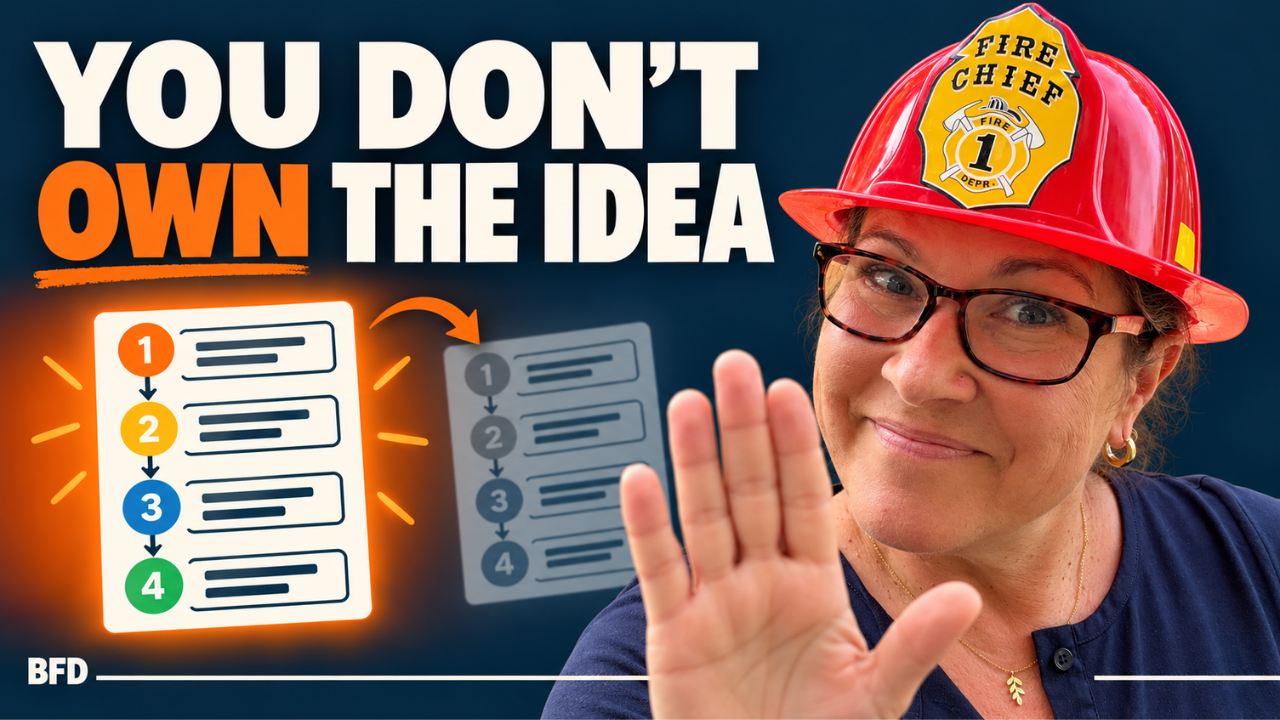
And here is the part few people will say and fewer want to hear: you don't own the idea. That's what Business Fire Drill 17, Before Someone Steals Your Offer or Framework, is all about.
You Don't Own the Idea
Take my own work. I teach North Pole to New York City (NP2NYC). I created the acronym, and it is a framework: cold traffic to a lead magnet, to the first time someone buys, to the second time someone buys. At its heart it's a sales funnel that I reworked in a way that made sense for me, and I named each of the spots. But I have no legal claim to the idea that a business moves from cold traffic to a lead magnet to an offer to another offer. A process has steps, and I can't own that.
The same goes for this series. I can't own the idea that business risks are like fires, or that you should rehearse before the fire happens. Anyone is free to use a fire metaphor.
What you can protect is narrower, and there are three tools: the name (trademark), the specific way you've written and presented it (copyright), and what the other person agreed to in writing (contract). Each answers a completely different question, which is why reacting in the first hour is your most expensive move.
The Alarm
A former client or student, someone you don't even know, launches something built on your structure. A contractor who helped you build your course starts teaching their own version. A competitor's sales page describes a process that matches yours almost step for step.
Reacting or Responding?
Reacting is assuming any similarity is automatically illegal and posting about it publicly. Or, if you're the one tempted to borrow, assuming that changing the name is enough to be safe. Neither is reliably true. Responding is knowing what you actually own, having it documented, and getting an attorney's eyes on it before you accuse anyone out loud.
Running the DRILL
D: Don't react. No public posting and no angry DMs. You don't own the underlying idea, only perhaps the name, the expression, and what's in a signed agreement. Once you've talked to an attorney, keep it to yourself publicly. Keeping your mouth shut helps you.
R: Record everything. Screenshot their page and yours with dates and URLs. Pull your dated drafts and original files. If they purchased, find out what they actually agreed to. Digital is fine, but for anything that could bring down your business, keep a paper copy too, so a digital lockout doesn't take away your only keys.
I: Identify the real risk. Is this a trademark problem, a copyright problem, a contract problem, or no claim at all? Those are four very different situations, covered below.
L: Lead with calm. Get an attorney's eyes on this before you accuse anyone publicly. A wrong accusation can cost you more than the copying ever did.
L: Lock in the lesson. Put real protective language in place before the next person gets access.
Tool One: Trademark
Trademark asks one question: is the public likely to be confused about who is behind this? It protects your name, your logo, and your slogan. If someone launched a program with a name confusingly similar to Business Fire Drills, selling to the same audience, that's a trademark question. If they teach their own steps under their own name, it isn't.
You get some rights just from using a name, but registration is much stronger, and you want to search before you choose a name, because picking one someone else already has rights to is trademark infringement. We'll go deeper in Fire Drill 18, Before a Brand Name Becomes a Problem, and if it ever comes down to a demand letter, Fire Drill 2, Before a Cease-and-Desist Arrives, walks you through it.
Tool Two: Copyright
Copyright protects your expression: your actual words, your slides, your workbook, your videos, and the specific way each lesson is written. It does not protect the idea underneath. If someone lifts your sales page word for word or copies and sells your workbook, that's a copyright question.
But enforcing copyright is expensive and intense. In the U.S., you generally must register the work before you can sue, and registering before the copying happens makes it easier to prove what's yours. Enforcement can run into the tens of thousands of dollars, sometimes far more. And you're going to rewrite your sales page, so you won't register every version. That's why Fire Drill 16, Before Someone Copies Your Content, asks you to decide your true crown jewels.
Tool Three: Contract
A broken contract is a sharper knife. With trademark and copyright, you have to prove the thing is protectable, that it was copied, and that people will be confused. With a contract, the question is much simpler: did they agree not to do this, and did they do it?
In an online business, that contract lives in your purchase terms: written terms someone agrees to, with a checkbox or a click at checkout, before they go behind the paywall. Not an email after the fact, and not a footer link nobody agreed to before getting access. You can't get someone to agree to the rules after they've already downloaded everything.
Here's a distinction people often miss. If you hire a contractor or team member, confidentiality works: what I show you about how my business runs stays between us. But for a course that's publicly for sale, it's much harder to call it confidential when anyone with a credit card can buy access. Instead, purchase terms set the rules of use: use it for your own business, but don't resell it, don't share your login, don't record and distribute it, don't repackage my materials as your own course or certification, and don't use it to build a competing program. How far those restrictions can go depends on your state and how reasonable they are, so have an attorney look before you enforce anything. (I break down the difference between non-competes and non-disclosure agreements in Untangling Non-Compete and Non-Disclosure Agreements.)
This is also why I keep saying crown jewels. You can only write a precise clause around something you can name. "Don't copy my stuff" is vague and weak. "You may not use these materials to create or sell a competing training" is specific and enforceable, as long as you define what competing training means. That kind of precision only exists before the fire. Once someone has your material and never agreed to anything, you're stuck arguing about ideas, which, remember, we don't own.
One limit: a contract binds only the people who agreed to it. A stranger who never bought from you can't be held to terms they never saw. That's why the best protection blends all three tools when the facts justify it.
Three Questions for the Program That Looks Just Like Yours
- Did they buy from me, and did they agree to written terms before they got in? That's contract, and it's a sharp knife.
- Is it my name, or one confusingly close to it? That's trademark.
- Is it my actual wording and materials, or just a similar structure? That could be copyright, or possibly no claim at all.
Three questions, three different responses. That's what identifying the real risk means.
The Fire Extinguisher
- Name your crown jewels: your brand name, your named frameworks, your flagship program. Not everything, and definitely not every blog post.
- Search, then investigate whether you should trademark the name of your framework or brand. It's not totally straightforward.
- Put clear written purchase terms in front of every buyer before they get access, with specific rules for how they can use your crown jewels.
- For contractors, team members, and anyone with deep access, get confidentiality and ownership language in signed documents. Non-competes are limited in many states, so run that one by an attorney. Confidentiality is a much stronger clause.
- Keep dated development records: your first outline, early slides, and drafts.
Fires like this are rarely one combustible thing. The name was never trademarked, the buyer never saw terms, and there's no record of when you built it. If it's already burning, screenshot everything with dates, pull whatever people signed or agreed to, and call an attorney before you post, DM, or send anything. Then be honest with yourself: is this worth the fight, or is this a lesson learned?
Your Next Right Decision
Option 1: Do nothing. Your names are protected, your buyers agree to terms, and your records are dated.
Option 2: Put the drill in place. This is right if any of those answers isn't true yet.
Option 3: Send this to a dear friend who is building a name around a brand or a framework.
Free homework: write down the name of your main framework. Next to it, answer: Is the name protected? Can it be? Should it be? Who has deep access to it, and what have they agreed to in writing? Keep paper copies of when you started using your crown jewels.
A great framework is always tempting to copy. That's actually a sign it's working. What decides the outcome is what you put in place before the copying happened.
Where's the smoke detector in your business? You live there, and it's supporting you financially. I built one for you: 11 questions, about 3 minutes, and it shows you which fires your business is most likely to have, including the ones already smoldering. Enter your email to activate it, then run it here: tamsenhorton.com/business-fire-drills
Business moments are predictable. Panic is optional. Run the fire drill before the fire alarm goes off.
Keep Exploring: Trademarks, Copyright and Protecting Your Brand
- Someone Copied Your Content? Why You Can't Stop It and What to Protect Instead — Fire Drill 16, deciding your crown jewels
- Got a Cease-and-Desist Letter? Here's What to Do Before You Panic — Fire Drill 2, when it comes to a demand letter
- Why You Need to Understand Trademark Laws — every business decision touches trademark law
- Can You Trademark Your Name? — yes, no, and the "secondary meaning" wrinkle
- How Do I Go About Trademarking My Business? — the practical next step if you decide to register
- Consequences of Trademark Infringement — what's at stake when a claim turns out to be real
- Understanding the Basics of Trademark Infringement — the plain-English version
- Avoiding Trademark Infringement for Online Course and Membership Site Owners — choosing a name that won't come back to haunt you
- The Terms and Conditions for Your Online Courses, Memberships, 1:1 Services — the basics of purchase terms
Listen to the Business Fire Drills Podcast
This is general educational information, not legal advice for your situation. Laws vary by state and country, so talk to an attorney about your specific facts.
Every business decision is impacted by legal — and we want those impacts to be positive.
If you’re building, creating, or using AI in your business, get my latest briefings directly in your inbox.
I’ll help you stay clear, compliant, and calm.
I send thoughtful updates — never spam. You can unsubscribe anytime. Emails are for education, not individual legal advice, and help you stay clear on the business impacts of law and your choices.
