Who Owns What AI Writes for Your Business? What to Check Before You Publish (2026)
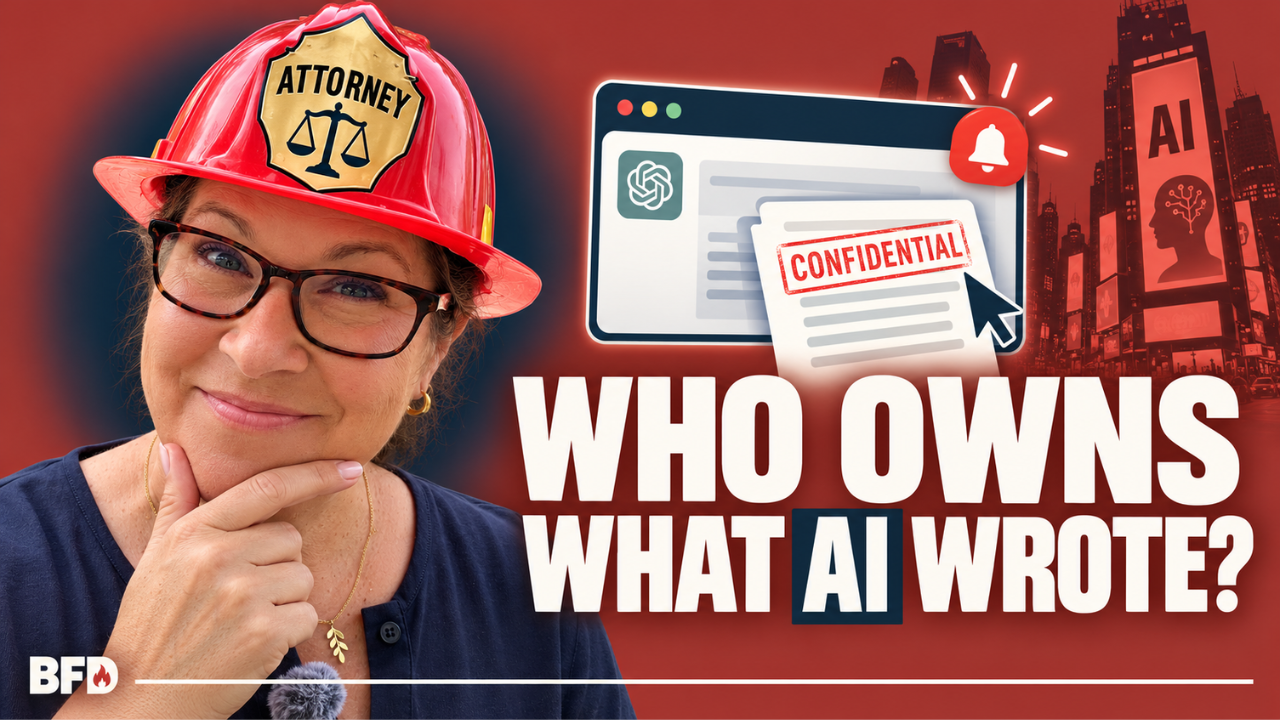
You paste your client's confidential intake notes into a free AI tool to get a quick summary. Or you publish a blog post an AI wrote in thirty seconds. Then a reader emails: "This paragraph looks really familiar."
That's a Business Fire Drill. And the best time to run it is before the fire.
Here's the part that surprises people: AI feels like a private conversation, and it isn't. It's a product, made by a company, with terms of service. Those terms decide what happens to what you type in, and who owns what comes out.
[WATCH ON YOUTUBE — embed code goes here]
The Alarm: What This Looks Like
- You pasted a client's information, a contract, or an unreleased launch into an AI tool and never checked what happens to it.
- You published AI-generated content everywhere and assume you own every word.
- Someone copies your AI-made workbook, and you find out you may not have the protection you thought you had.
Reacting is assuming the output is yours, original, and safe, and that whatever you typed in disappeared. Responding is running the drill.
Run the Drill: D-R-I-L-L
D: Don't react. Don't assume. In the U.S., work made entirely by AI, with no meaningful human contribution, generally can't be copyrighted. Your own writing, edits, and stories can be. This area moves fast, so treat that as a snapshot in time. And almost no tool promises its output is unique. Extinguisher piece one: for every AI tool you use, find three answers in its terms. Who owns the output? What happens to what you type in? Who is responsible if something goes wrong?
R: Record everything. Piece two: a list of every AI tool in your business, including your team's and the AI note-taker on your calls, with the plan you're on. Digital is fine, but for anything that could bring down your life, your finances, or your business, keep a paper copy too, so a lockout doesn't lock you out of your own records.
I: Identify the real risk. There are three fires under this one name: ownership (can you protect what comes out?), infringement (does it echo someone else's work?), and confidentiality (what are you putting in?). Piece three: sort your AI use into those three buckets.
My own rule: if what you're putting into AI could bring down lives, finances, or your business, don't put it in. Law is the cleanup crew. I use AI with the expectation that whatever I put in could end up on a billboard in Times Square. And if something goes wrong, the person who was hurt is coming after you, not after the AI tool.
L: Lead with calm. Piece four: a short AI rule for you, your team, your contractors, and your clients. Which tools, what never goes in, and what can. Easy to remember, easy to follow.
L: Lock in the lesson. Piece five: put that rule in your client agreements, purchase terms, and contractor agreements, and check it every few months, because tools change their terms constantly.
If It's Already Burning
Don't panic-delete, and don't panic-post. Figure out exactly what went into each tool. Hold on to anything you suspect echoes someone else's work. If client information is involved, get an attorney's eyes on it before you say anything publicly. Usually a few things are burning at once, which is why we do this before the fire.
Your Next Right Decision
- Do nothing. You know how you use AI, you've read your tools' terms, and your documents reflect your use.
- Put the drill in place. Even if you don't think you use AI, the platforms you use probably have it built in. Notion does. Kajabi does.
- Send this to a friend who uses AI all day and has never read a terms page.
This was the short version. Want me to go deeper on the copyright piece, what to put in your AI rules, or what to say to a client? Leave a comment on the video and tell me what you want.
Keep Exploring
- Can You Use a Customer's Testimonial Without Asking? What to Get in Writing in 2026 (Fire Drill 20)
- Who Owns Your Course If a Contractor or Collaborator Helped Make It? (Fire Drill 19)
- Someone Copied Your Content? Why You Can't Stop It and What to Protect Instead (Fire Drill 16)
- The Unexpected Employee: Your Business's Privacy Policy
- The Terms and Conditions for Your Online Courses, Memberships, 1:1 Services
- The 4 Legal Pages Your Kajabi Site Needs
Listen to the Business Fire Drills Podcast
Where's the smoke detector in your business? Eleven questions, about three minutes, and it shows you which fires your business is most likely to have. Run it here.
This is general educational information about U.S. law, not legal advice for your situation. Talk to an attorney about your specific facts.
Every business decision is impacted by legal — and we want those impacts to be positive.
If you’re building, creating, or using AI in your business, get my latest briefings directly in your inbox.
I’ll help you stay clear, compliant, and calm.
I send thoughtful updates — never spam. You can unsubscribe anytime. Emails are for education, not individual legal advice, and help you stay clear on the business impacts of law and your choices.
