Who Owns Your Course If a Contractor or Collaborator Helped Make It?
You hired a designer for your course. A friend helped you build the workbook. Your virtual assistant has been writing your emails for two years, and a coach co-hosted your podcast. Everyone was friendly, everyone was excited, and nobody thought about paperwork.
Then the thing takes off, and somebody says, "Wait. Isn't part of that mine?" Or a buyer asks whether everyone who worked on your course has signed an agreement, and you realize you don't know.
Here is the part that surprises people: ownership disputes almost never happen over things that failed. Nobody fights over a course that sold three copies. They fight over the one that made six figures. So the time to settle who owns what is when nobody knows yet whether it will work, while everybody is still on the same side. Business moments like this are predictable, and your panic is optional.
The Alarm
It rarely arrives as a siren. It sounds like a former collaborator emailing, "I think I'm entitled to a share." Or a designer saying you can't use your own logo without their permission. Or someone you paid saying, "I made that, so it's mine." Almost always it traces back to one sentence: "We'll figure it out later."
Reacting or Responding?
Reacting is assuming that paying someone means you own what they made, or that because you're friends, nobody would ever make a claim. If the fire has already started, reacting is firing back an angry email, posting about it, or announcing "you have no rights" before you've looked at anything. Responding is knowing what you actually agreed to, having it in writing, and making that agreement before the work starts.
Running the DRILL
D: Don't assume. Payment doesn't settle ownership. Friendship doesn't settle it. "Work for hire" isn't automatic. As a rule of thumb in the United States, whoever creates something owns it by default, including a freelancer or contractor, and paying them doesn't automatically transfer ownership. You generally need a signed writing. Employees are different, but contractors, collaborators and friends are not employees. And if two people create something together with no agreement, they can end up co-owners, which is the opposite of what most people want.
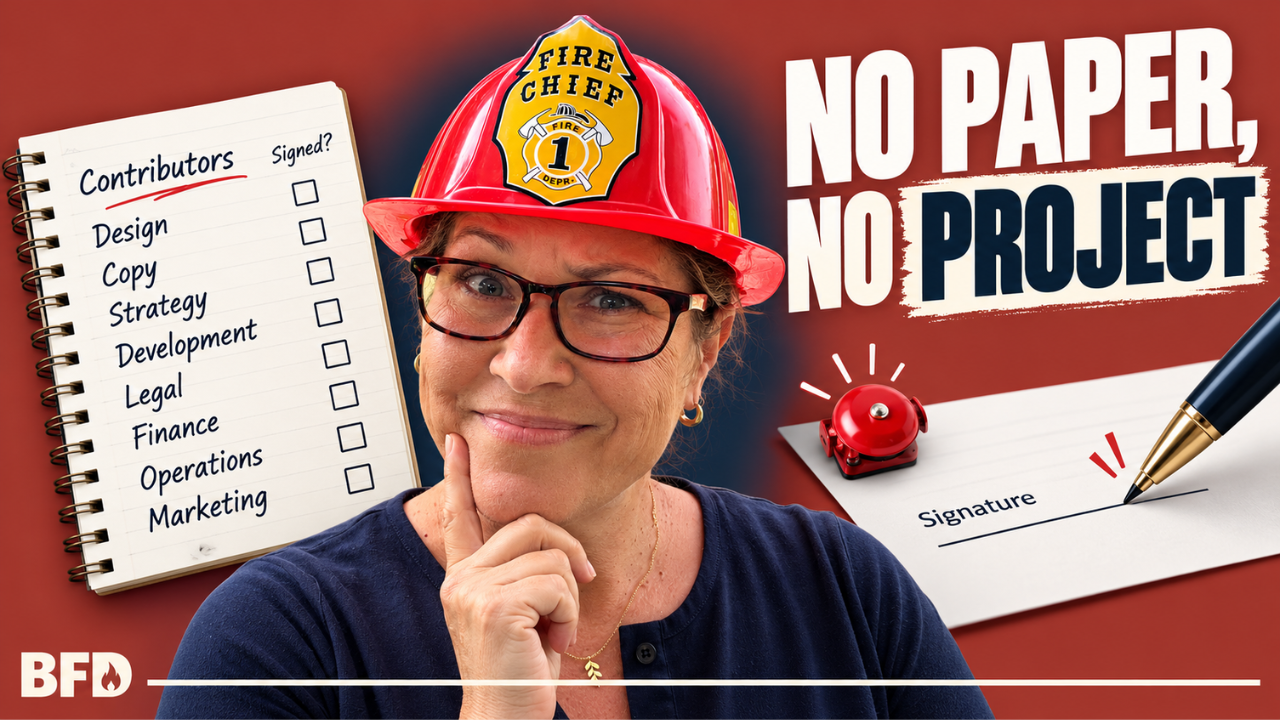
R: Record everything. Write down every person who has ever contributed to something you sell or are building: the designer, editor, writer, assistant, guest expert, co-host, the friend who helped with the workbook. Next to each name, note what they made, when, and what you have in writing, even if the answer is "nothing." That's your contributor map. Digital is fine, but keep a paper copy of anything that could bring down your business, so a lockout doesn't take your records with it.
I: Identify the real risk. Ask how central the work is (your flagship course or logo, or a few social posts) and what kind of relationship it is. A contractor needs an agreement that says you own the work, with real assignment language, not just the words "work for hire." A guest contributor needs an agreement that says what you can use, where, and for how long. A true co-creator needs an agreement about who owns it, how revenue is shared, and what happens if you part ways. Three different people, three different agreements.
L: Lead with calm. Most people never ask for the paper because they fear it signals distrust. It doesn't. Try: "I put an agreement in place with everyone I work with. It protects both of us." Anyone you want to work with will say, "Great, send it over." If someone pushes back on clear ownership language, you learned something valuable before the money, not after. For true co-creation, get an attorney's eyes on it.
L: Lock in the lesson. Make "no paper, no project" a standing rule. Every agreement has ownership language, every new collaborator gets the same simple process, and once a year you review your contributor map and fill the gaps.
What Clear Ownership Language Covers
- Who owns what was created
- What the other person can and can't do with it afterward
- Whether they can use it in their own portfolio
- Whether they get credit
- How money is shared, if there is a share
- What happens if you stop working together
If those questions have written answers, you're ahead of most businesses. This is the United States rule of thumb; if you or your collaborators are in other countries, the rules can differ, which is one more reason to put it in writing.
The Fire Extinguisher
- No paper, no project: nobody starts creating for your business until the agreement is signed.
- Your contributor map.
- The right agreement for the right person.
- A simple way to ask.
- A standing rule, so it never depends on your memory.
You don't have to draft these agreements yourself, but you need to know what belongs in them so you can tell whether what you've been handed says it. The Contributor Agreement is included in the Legal Bundle Generator, one corner of Legal Infrastructure.
If It's Already on Fire
The drill doesn't change; you're just running it with smoke in the room. Don't concede and don't deny, not in an email, a text or a post. Pull every agreement, email, invoice and message about what was agreed. Write down the real history of who made what, and when. Be honest about what you do and don't have in writing, and get an attorney's eyes on it before you respond. What matters is what was actually agreed to, not who worked hardest and not how it feels.
Your Next Right Decision
Option 1: Do nothing. Everyone who has ever helped you create something has a signed agreement with clear ownership language.
Option 2: Put the drill in place. This is right if any collaboration has ever happened on a handshake.
Option 3: Send this to a dear friend who is building something with someone else's help and hasn't put it in writing.
Free homework: make your contributor map. Everyone who has helped you, what they made, and what you have in writing. Especially if the list is short.
Where's the smoke detector in your business? You live there, and it's supporting you financially. I built one for you: 11 questions, about 3 minutes, and it shows you which fires your business is most likely to have, including the ones already smoldering. Enter your email to activate it, then run it here: tamsenhorton.com/business-fire-drills
Business moments are predictable. Panic is optional. Run the fire drill before the fire alarm goes off.
Keep Exploring: Ownership, Contractors and Collaboration
- Can I Use This Business Name? How to Check a Brand Name Before It Becomes a Problem — Fire Drill 18, the name behind the work
- A Contractor Just Said They Were Misclassified — Fire Drill 3, the contractor side
- Independent Contractor v. Employee — why the difference matters
- Collaborations & Co-Creating: Friend or Foe? — when you build something together
- Mastering the Art of Co-Creating Content for Successful Business Collaboration — guest contributors and co-created IP
- Thriving Online Partnerships: Guide to Business Collaborations — finding and structuring partners
- Someone Copied Your Framework? What You Can Actually Protect — Fire Drill 17
Listen to the Business Fire Drills Podcast
This is general educational information, not legal advice for your situation. Laws vary by state and country, so talk to an attorney about your specific facts.
Every business decision is impacted by legal — and we want those impacts to be positive.
If you’re building, creating, or using AI in your business, get my latest briefings directly in your inbox.
I’ll help you stay clear, compliant, and calm.
I send thoughtful updates — never spam. You can unsubscribe anytime. Emails are for education, not individual legal advice, and help you stay clear on the business impacts of law and your choices.
